Authentic Earl Grey Tea mixed with Chenpi (aged tangerine zest) creates a very evocative blend of tea. Last year my Earl Grey was called Pinkies Out! — it was quite popular, so I ordered it again in 2025 — same producer, same style, very different result. Pinkies Out! and the whole story about it revolved around mature sexiness and femininity, I just — really don’t get that this year. I understand that it might be a bit hard to follow when talking in such abstract terms, but I’ll lay out my line of thought when it comes to renaming/rebranding this tea to what it is today, because there are always circumstantial elements that go into these things.
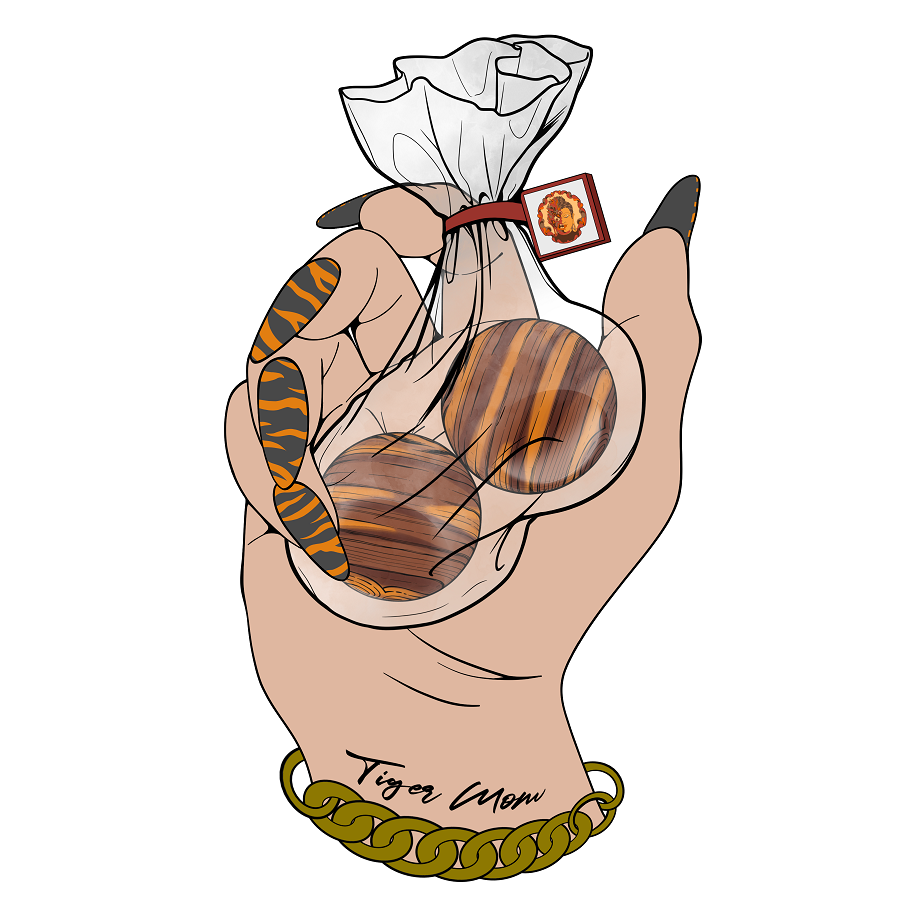
There’s an instagram account I follow that draws ‘SFW NSFW’ — a concept I really like. That’s @buboossenchan incase you wanted to visit. She has various videos about interacting with bags of marbles, a concept I have yet to touch on. Circumstantially, finding that account had a lot to do with this image. The name ‘Tiger Mom’ was the final step, and had nothing to do with shaping the image at all. The bag of marbles became a bag of tiger-eye gemstones, which turns out, are quite hard to draw. One early concept was going to be a tigers head with the bag of marbles in its mouth, but then a customer I showed the concept to mentioned tigers being a bit of a branding cliche these days, which I agreed, and thus retreated from that idea. I took some photos of my hand in different poses (chose this one), traced it out digitally, and the rest of the picture is built from there.
Why a tiger motif at all? 2 reasons. Mixing chenpi into this tea gives something of a tiger-tail ice cream flavor, and that chenpi also gives a flavor that is like chinese medicine, which if I think of tigers and chinese medicine I immediately think of ‘tiger penis soup’ — something that people historically (still might) drink for virility. I might have gotten away with drawing a tiger penis for a label, but after doing some research, just wasn’t feeling it.
Why blend the earl grey with chenpi? As I look more and more into tea history, and live longer, and form opinions about the world, it just seems very far fetched that bergamot was the original citrus used in this blend. I say that because guangdong china had already had a history of adding tangerine zests to tea as a flavoring, especially to puerh tea from yunnan. To me it’s most likely that this ‘mysterious gift’ of tea I will speak about soon was black tea flavored with chenpi, and it was just a diplomatic gift of tea from a businessman or politician in china (because charles grey was a prime minister and thus held some power)
Anyhow. Tiger Mom is a robust, to the point, typical earl grey made of quality tea leaves. It has little bitterness or astringency, and uses a good amount of bergamot zest. It’s totally up to you if you want to add the chenpi (while they’re packaged together, you have to crack the zest in yourself) but I recommend it anyway. I have another article on chenpi here if you want to read more about it.
I finalized on 6.2g of Earl Grey and 1.2g of Chenpi per 330mL brew. Using boiling water. Steeped for 2m38s
Below this line is just leftover information from last year, you may find use in it, or find it fascinating.
A few days later… (The Article)
Earl grey is the worlds most famous flavoured tea!
The origins of earl grey are contested, here are the possibilities though:
Charles Grey the 2nd was the prime minister of British Empire between 1830 and 1834, he is credited with flavouring tea with oil derived from the zest of bergamot
- It’s likely that Charles Grey the 2nd was given a gift of bergamot/other citrus flavored Chinese tea as a gift (from someone unknown)
- Jacksons of Piccadilly claims production of Earl Grey since 1830 since they learned the recipe from Charles Grey the 2nd.
- Sam Twining of R. Twinings Tea and Co. claims that Richard Twining prepared a bergamot flavored black tea for Charles Grey the 2nd in 1832 and gave the tea his name. The first British-made tea arrived in England in January 1839, it was tasted by R. Twining and found to be unsatisfactory it was flavoured with bergamot (as the aforementioned tea was several years earlier) to disguise its quality and sold under the brand of ‘earl grey’.
Whether or not anything above is true, bergamot zest oil soon became a popular additive to mask the flavors of poor quality black tea, it was also highly compatible with milk and sugar which gave birth to London Fogs.
Jacksons of Piccadilly to this day (under the Twinings brand) still makes Earl Grey based on Chinese black tea which they claim is the original recipe, but…
In food science, ways to delivery more powerful sensations, prolong shelf life, and cut corners in cost have been invented over the years. Maltodextrin for example is a derivative of tapioca that can suck oil into it like a sponge and hold it in a solid powder form. Techniques like this to transform oils into a dry and stable form are how most mint teas and low quality jasmine teas are made today. In the case of Earl Grey, Twinings for example will add white granules of ‘bergamot flavoring’ into finely shredded black tea. These granules will dissolve in water and release their flavor, but that flavor will be consumed in the first pot, giving no opportunity for flavorful multiple infusions.
I don’t particularly care about the origins of earl grey, but I remember going out of my way to buy a tin of it for the Consul General of Japan’s birthday gift back around 2009. I tried several Earl Grey’s out at the time because I wanted to buy him a good one, most were unpleasant, and I came to associate earl grey tea with the aroma of nauseating oil based paints, and it was confusing for me that someone would ask for such an unpleasant gift.
You only know what you’re exposed to, and if you’re exposed to something long enough, you’ll generally come to regard it as true. A problem with all types of connoisseur driven pursuits is a feeling like you cant empathize with someone who enjoys something, even after trying something 10 times, you feel like you’ve given something your best shot and still don’t like it. Be tenacious, you’re capable of more. A true connoisseur would never give up. That mentality is what led me to finding many of my greatest teas, and I will acknowledge that I’ve come a long way in my pursuit of finding a good earl grey (this one is dope)
Kids these days are drinking a lot of milk tea, boba; bubble tea as we used to call it. You cannot use a fine tea as a base for boba. The tea needs to suck, it needs to be rough and powerful, otherwise the addition of milk and sugar will overpower the tea flavor make it taste ambiguous. The requirement for bad tea to obtain a good result is a very rare occurrence in these sensory pursuits. Generally in culinary life, the mentality is: “don’t try to save something that spoiled”. If a sauce is burned, start again. If you have a wine that tastes like shit, don’t cook a stew with it, pour it out. Fine quality ingredients will make a fine quality result, and the mentality that quality ingredients are coming together to make a finished product that is more than the sum of its parts is what this earl grey is about.
An organic spring harvest of Dian Hong (Yunnan black tea) from very high elevations at about 30% pekoe cover, blended with Calabrian bergamot oil. This is using oil, not flavouring, not lab created pellets. This is real, authentic earl grey. Enjoy it!
Notes on Brewing:
All tests done with boiling water.
I’ll place my experiences organized by their strength (ratio of g:mL)
5g tea : 330mL (1:66) @ 3m15s was brisk and brown, like the old ‘Brisk’ iced tea, feminine, powdery, lace (sexy elegance)
5.5g tea : 330mL (1:60) @ 2m45s had ‘purple’ pegged as the main aroma, though it might not be strong enough
5.9g tea : 330mL (1:55.9) @ 2m45s had aromas more like tea, it’s brown and brisk. The flavor was light and perfume-y. The astringency rubs against the tongue but doesn’t grip.
6g tea : 330mL (1:55) @ 2m30s had typical earl grey aromas, but the focus was on orange floral notes such as orange flower water, and typical black tea notes. It was easy drinking, floral, perfume-y, and ends a little astringent but not enough to be a real issue.
6g tea : 330mL (1:55) @ 2m38s smelled milkier/creamier than 2m30s. The texture was also oilier and creamier. The flavor was perfume-y but not to a fault. Although texturally it’s heavier than 2m30s, it doesn’t seem as astringent.
6g tea : 330mL (1:55) @ 2m45s had ‘purple’ as the main aroma, it is soapy now, but the flavor balance is very good.
6.1g tea : 330mL (1:54) @ 2m45s was purple, floral, feminine, panettone. Flavor was loud, bold, the texture was pretty nice when it was hot, but as it cooled the astringency became a real issue. I eventually grew to dislike it.
6.2g tea : 2m52s (1:53.2) @ 2m52s doesn’t smell soapy, the aroma is complex, on the cusp of purple and brown. It’s probably too rich?
From all the above notes, I think if one was to drink Earl Grey straight (without milk or sugar) I would recommend 6g tea : 330mL (1:55) @ 2m38s
Though if one were to add milk and sugar, it would need to be stronger. I will do some testing in the future and update this.
The Recipe Creation for Earl Grey with Milk and Sugar
What a can of worms I’ve opened here. The back of my tongue is literally dyed brown from all this black tea I’ve been tasting over the past several days. It’s gross, you’re welcome. This is going to get very overly complicated because we’re introducing a lot of new variables into the brewing process. It’s important to understand that my final result is a blend of different ratios. So it’s important to track the amount of drinkable liquid tea used each time. When you brew a pot of tea, you lose some of the water to re-hydrating the tea leaves. 330mL of water into a tea pot does not mean 330mL of water comes out. I’ll get really into this later on, brace yourself.
I should say for the record:
I am using white refined sugar for these tests, it’s probably better to use something else, but white sugar is what I have on hand.
I am steeping the teas below for 2 minutes, it might be better to go longer, that’s fine tuning I’ll do in the end, if I can keep my sanity.
The first 4 infusions below (before **days later**) were done with homogenized milk, the latter infusions were done with UHT milk with a similar fat content. The UHT milk has significantly more protein and less sugar than homogenized milk.
I’ll place my experiences organized by their strength (ratio of g:mL)
1:35 (9.4g tea : 330mL water) –> 307g of brewed tea
1:70 sugar:tea ratio (4.3g)
3:1 tea:milk (102g)
Result: It’s probably too weak/milky. It’s clearly earl grey and its pleasantly creamy and sweet. It’s very gentle though.
1:10 (33g tea : 330mL water) –> 267g of brewed tea
1:60 sugar (4.4g)
4:1 tea to milk (66.7g)
Result: No matter how you look at this, it’s too strong. Even diluting it like crazy with milk is still strong, and using 30g to brew 1 drink is very expensive. As I was experimenting very casually with the latter half of this drink, pushing the sugar stronger than 1:60 had good results.
1:27 (12.2g : 330mL) –> 298g
1:60 4.96g
3:1
Very good! A bit too milky, and I think perhaps it could be a bit stronger tea taste and sweeter. I would be comfortable to establish this as the minimum level of acceptable flavor in a London Fog that I create.
1:25 (13.2g : 330mL) –> 399g out
1:58
2.9:1
Is my tongue broken? Am I london-fogged out? Either this is too balance or I should just stop for the day.
**days later**
1:30 (11g:330) –> 301g out
1:58
2.9:1
Easy drinking, fragrant tea scented milk. It becomes obviously earl grey and more perfume-y as it cools down. It’s pleasant, but probably too weak. This is not just my opinion, but my families too.