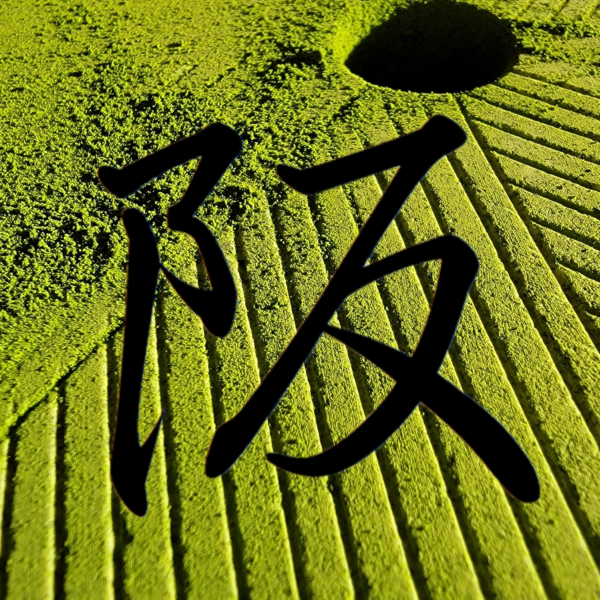
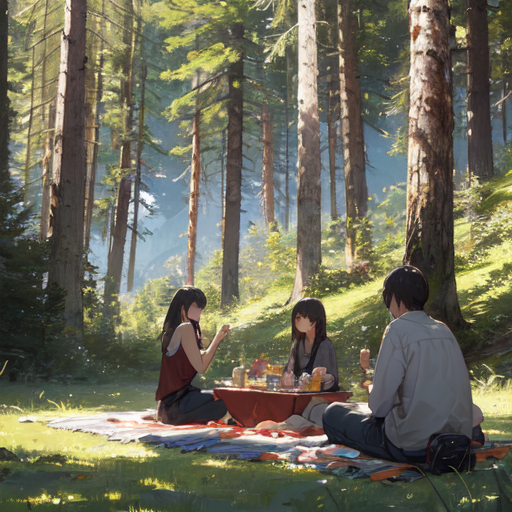

This label is complete AI, it was the first AI image I made when I learned AI could even make images. I don’t remember the tool… Dall-E or something we don’t even hear about anymore (oh how it moves fast). I prompted the image generator with my tasting notes and got this. I thought it was a neat concept.

Sciencey, Factually important stuff:
Making an occasional appearance on China’s top 10 tea lists is a green tea made in an old fashioned way by today’s standards, it’s called called Lu Yu (translating to Jade Dew). Lu Yu is grown in the Eastern outskirts of Enshi City, on the Wufeng mountains of Hubei province, China. It is one of China’s few remaining steamed green teas, boasting production methods used since 500 AD. Similar to the Mao Jian green tea I had years ago, the selenium content of Lu Yu is above average. The name Jade dew 玉露 has the same characters that Japan uses for gyokuro. These teas don’t have a lot in common other than they’re both steamed green teas though.
Enshi Lu Yu is made from a localized clonal cultivar called Enshi Qun Ti Zhong normally found around Western Hubei. The Wufeng mountains have abundant cloud cover and rainfall. This creates ideal conditions for low-light green teas that have high L-theanine content.
In the old days of the Tang dynasty, when tea really started to become a new phenomenon, the manner of its creation was to pick leaves, steam them, and pack/compress them together into bricks much like we see in Pu’Erh and Fu Zhuan Cha today.
In order to keep the tea leaf green (its original color), an enzyme that can transform that color must be killed/deactivated. These enzymes are killed with heat, the leaf needs to reach a temperature of about 75 degrees celsius for 7 seconds to accomplish this. For the record, this 75 degree 7 seconds is very modern information, this steaming process would last about 30 to 60 seconds traditionally.. I digress, Putting leaves into a basket and steaming them was the original manner in which all teas were ‘fixed’, but this fell out of favour to a pan frying method using a wok. The standard in China from then until today is to use a wok; because of the high heats used, special care must be taken to avoid burning the leaves, but because such a high heat is used, special fragrances and flavors are able to be coaxed from the leaves if this process is done skilfully.
When Japanese monks were studying zen Buddhism in China, they witnessed this tea production method using steam and brought the knowledge back to Japan. As I mentioned above, eventually China moved on to the wok, but Japan stayed with steam. The paths diverged from this point leading to what we have today.
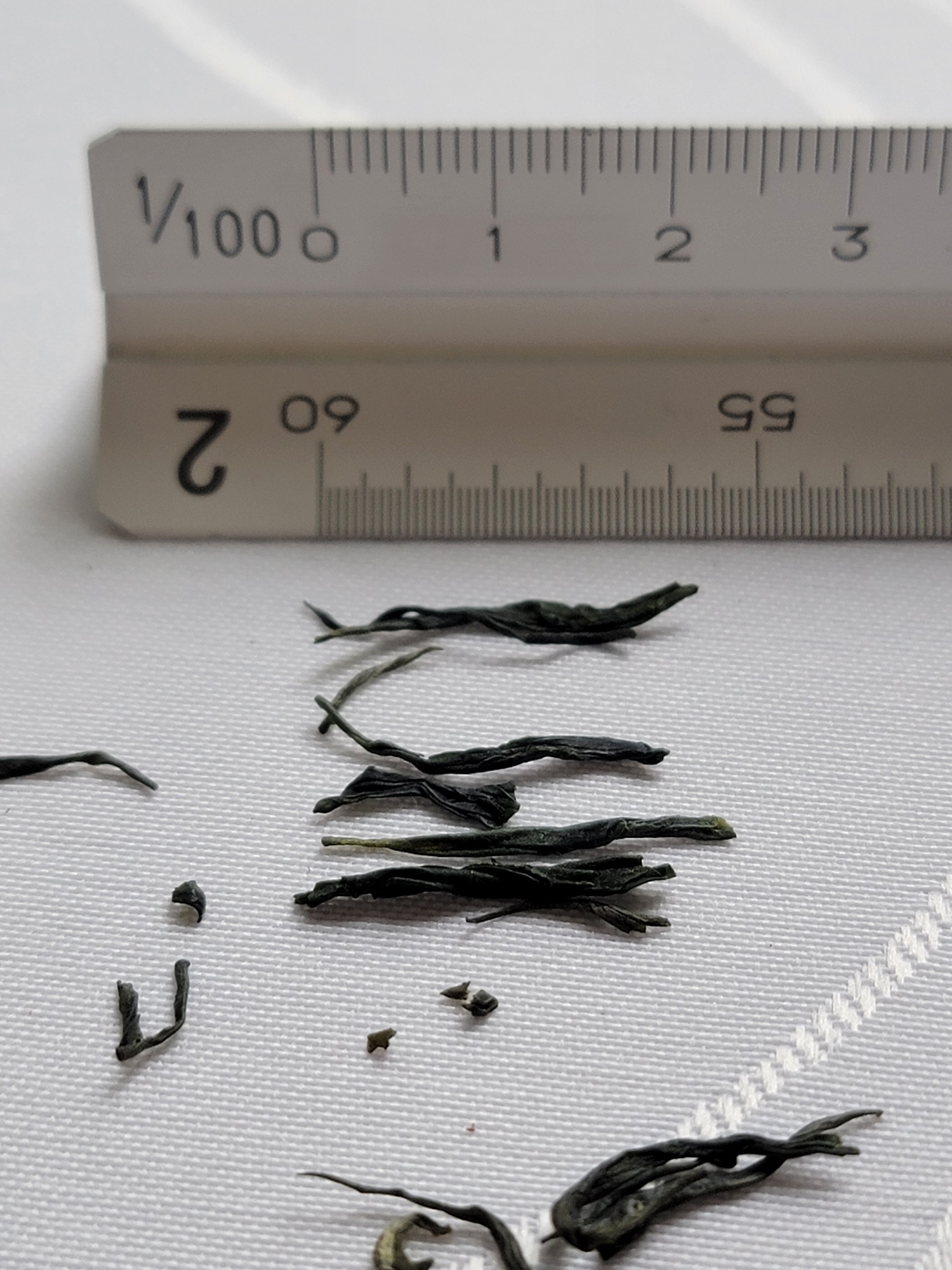
There was a point in history where the appearance of the dry leaf started to matter more to the poetic minds of tea drinkers, that different shapes could be talking points and evoke certain thoughts. There are many teas today that have iconic appearances that brick compression would have never allowed for: long jing, tai ping hou kui, anji bai cha to name a few, the reason I bring this up is that Enshi Lu Yu is rolled by hand to get an appearance similar to pine needles, and once this is accomplished the tea is pan fried at low temperatures. This colors the dark green leaf a slightly ashy grey and enhances both the aroma and perception of sweetness. Enough about all that, how does it taste and why should you drink it?
Opinionated Stuff:
Will this tea change your life? …No? I guess unless it’s the first tea that you ever try from me, and your exposure to tea has been very sheltered until this point, no, it probably wont change your life (it could though! just saying!). But does every tea need to change your life? No. No of course not. If every tea changed your life, why would anyone strive to create something great. Look, it’s okay to be normal and drink normal stuff. This tea probably wont change your life, but it’s $10 for approximately 10 pots of completely hand made tea from across the world; and if you care about my opinion at all, and you probably might, I expect that’s why you’re here, I’ll put my reputation on the line and say this is great tea. It’s excellent value, with great flavor, and a portal (for the uninitiated) into the world of what Chinese green tea tends to portray (whimsy, delicacy, grace, and elegance). You can spend a lot more money on green tea, with none of that dollar value reflecting quality or flavor but instead reflecting things like scarcity, fame. You can also buy from someone who you can trust, spend very little, and get it all!
and hey… if you want to spend money, look at the other green teas I’m offering on this site. You’ll go broke fast, but you’ll love every second of it. While this, and a few other teas on this site are ‘daily drinkers’ for casual enjoyment, if you want to go CRAZY and see some world class stuff. I offer them. They tend to be the ones with a weird labels, go figure.
Ok, ok, so how does this taste?
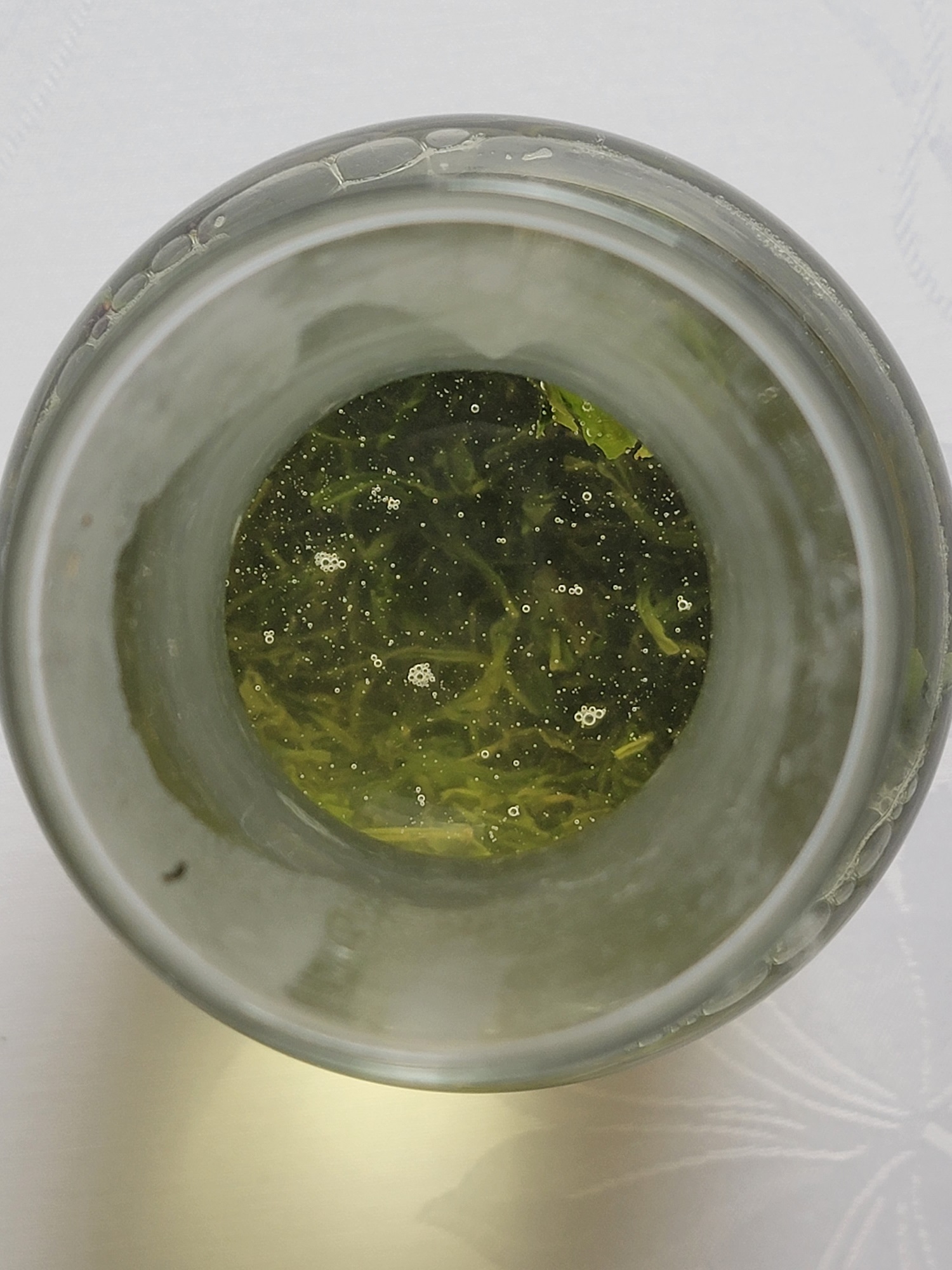
First thing, water temperature if very fussy for this tea. I’m sorry, you get what you pay for. Expensive teas tend to share a pattern in that they’re worth such amounts of money because they’re very easy to make, you almost can’t screw them up. This isn’t one of those teas, you’ll have to put in a bit of effort. It’s easy, don’t let me scare you. Bring water to a boil. You’ll want to create a ratio here where every 80g of water requires 1g of tea, if you use a scale, this is very easy. You could brew it stronger, but in my opinion, 1g tea:70g water was too strong, to each their own. Pour off the amount of water you’ll need for the tea, set it aside and let it sit for 2 minutes. Whatever temperature it becomes after 2 minutes, it’ll be close to what you want. The next part is visual. Add the water to the tea. If you’re brewing in glass, you’ll be able to observe a green color starting to emanate from the tea leaves at about 1 minute and 45 seconds into brewing. That green is sort of like.. this color:

The hotter the water, the faster the tea will exude this color; and as it accumulates, this green will concentrate and darken. This isn’t a science, but I don’t like when the tea is anywhere near this color. I prefer it much paler, and much more clear. You can experiment and find what you like, but I’ll restate that the flavor of this tea, seemingly more-so than many others I’ve tried recently is very dependent and finnicky with temperature. So if you’re finding that you’re not really enjoying it as much as you believe you should be, it’s probably a temperature issue, or you’re brewing it too strongly. Weaker seems to be my preference for this.
I bet you’re wondering how it tastes, well my friends, let me tell you!
It has a very natural green sweetness. If you could imagine opening up sugar snap pea pods and just eating the little peas inside one by one, that’ll be a start. Do you know iceberg lettuce? Well if you meticulously peeled each layer off from the core and painted them with simple sugar syrup before dehydrating them into big beautiful green sheets of sweet lettuce flavor, that’ll be my second flavor note. Could you imagine sitting out in a beautiful meadow dotted with wildflowers on a blue and white checkered picnic blanket, picking the things I just mentioned out of a little wicker basket and enjoying them in that setting? We’re getting closer. Could you imagine that the wildflowers that were all around you were actually edible flowers called nasturtiums? (If you’re unfamiliar, they’re a bit cress-like, though that may not help you at all!) and that you also brought with you a pint of strawberries that you bought from the store? They were all washed, but before you got around to eating any of the things we’ve discussed, you ate one of those strawberries, but it wasn’t quite ripe (the store bought ones never really are…) and that green taste the strawberry had never really left your mouth.
Oh my god, my manner of writing is so frustrating for you! I can feel your patience with me running out, so I wrote the following bit from the future.
Let me summarize the last little bit in a way that neatly ties it all up.
When this tea is made well, the tea is sweet. It’s naturally sweet like peas, and fake sweet like candied lettuce. It’s also dynamically ‘green’, because on one hand it’s sharp in the floral, cressy sort of way that nasturtiums are, but on the other hand, it’s dull in a sort of fruity, juicy, rotund way, like the under-ripe flavors in store-bought strawberries. It’s very bright, very relaxing, very open to multiple interpretations but mostly it’s aloof, and will conjur up whimsical fantasies about laying under the sun on a patch of grass, that somehow doesn’t have ants bothering you. That’s when the tea is made well; when the tea isn’t made well, it just tastes like good green tea! Ciao!
1g tea : 80g water, 2 minutes to steep, using whatever temperature water becomes when it’s poured from the kettle from boiling point and allowed to cool for 2 minutes at room temperature